
The State of the Economy: Key Insights from NCCI’s November 2026 Analysis
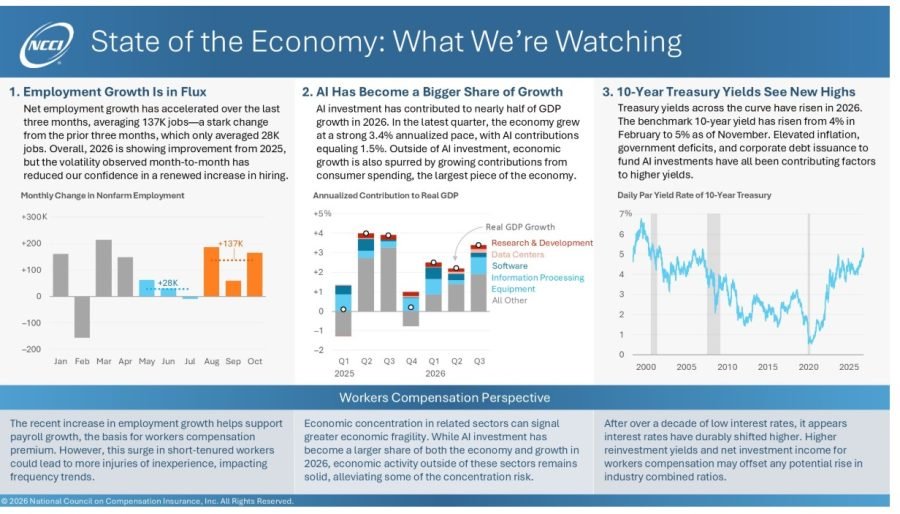
NCCI’s recent article, “State of the Economy: What We Are Watching – November 2026,” highlights the main economic forces shaping workers’ compensation across the United States.
Why should we care? Well, Economy = Jobs = Payroll = E-Mods or Insurer Rates = premiums
You can receive a one-page chart that covers most in the first link in this article – worth it.
Economic Growth and Labor Market Patterns
The U.S. economy in late 2026 continues to grow steadily, with moderate GDP expansion and ongoing job creation. NCCI notes that while the labor market remains robust, some sectors are showing signs of cooling after several years of rapid recovery and expansion. The service and healthcare industries continue to drive employment gains, though the pace has slowed compared to previous years.
Inflation and Wage Growth – Effect on State of The Economy
Inflation remains a key concern for businesses and insurance companies alike. NCCI’s analysis shows that while inflationary forces have eased compared with the highs of 2024-2025, costs for goods, services, and medical care remain elevated. Meanwhile, wage growth has moderated, but overall compensation continues to rise, affecting premium calculations and claims severity in workers’ compensation.
Workers’ Compensation Claims Activity
NCCI reports that claim frequency has stabilized, following the volatility experienced during the pandemic and the subsequent economic recovery. Claim severity, however, is still influenced by higher medical costs and changing workplace safety standards. The organization is also monitoring how changes in workplace practices, including remote and hybrid work, are impacting claim patterns.
Regulatory and Policy Developments
State-level regulatory changes continue to shape the workers’ compensation environment. NCCI’s November report discusses recent legislative updates and their potential effects on insurers, employers, and injured workers. Key areas of emphasis include benefit adequacy, medical fee schedules, and initiatives to improve return-to-work outcomes.
The Road Ahead
NCCI concludes that the state of the economy is relatively stable, but new risks and opportunities still require vigilance. Technological developments, demographic shifts, and global economic uncertainty will continue to influence the workers’ compensation system. Stakeholders are urged to remain proactive and adapt to the changing environment to help ensure the system’s continued health and fairness.