
NCCI Study – Workers Comp Medical Treatment Pattern Changes
Workers Comp medical treatment patterns appear to have changed since 2016.
Do My Six Keys Need Updating?
A very interesting study report was released last week, authored by NCCI’s Carrie Wang. One area that surprised me was the delayed initial medical treatment. One would expect this to make claims more expensive by extending treatment periods. That defies my keys to workers comp days that I authored in the early 1990s.
I had found that delayed medical treatment resulted in a spike in medical costs and treatment. The study results showed the delay had no effect (amazing).
One area I noticed in our claims/loss run reviews during the pandemic was significant hesitancy about initial medical treatment. The injured employees were also hesitant to attend follow-up appointments.
Another important study finding that agreed with mine, providing good medical treatment at a lower cost, was industrial walk-in medical clinics. The study seems to show that non-facility treatment has increased – and that it is a good development.
______________________________________________________________
The Study
NCCI’s latest research examines how time to first medical treatment and treatment duration changed from Accident Year 2016 to 2023 and how the changes in these two measures relate across jurisdictions. This report reveals several shifts in when and where injured workers receive first medical treatment, as well as how treatment patterns vary.
Medical treatment patterns for workers compensation claims have evolved in recent years, particularly for specialty services such as major surgery and physical therapy. While aggregate trends across NCCI jurisdictions appear modest, there are substantial differences at the state level.
KEY INSIGHTS
Initial medical treatment is occurring later in most jurisdictions
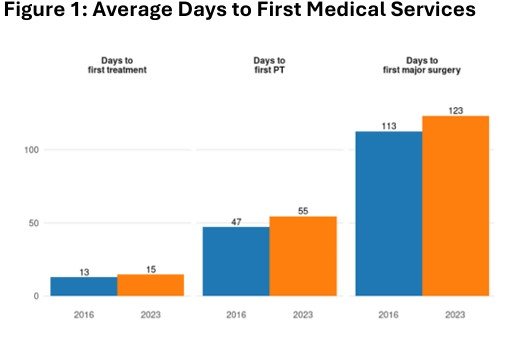
- From 2016 to 2023, average time to initial treatment increased by 2 days, with a larger increase of 8 days for first physical therapy and 10 days for first major surgery.
- The share of claims treated on the injury date decreased from 48% to 43%.
- Among claimants treated after the injury date, more received initial care in non-facility settings, where initial treatment typically occurred later but overall medical utilization was lower.
Treatment duration remained stable overall, despite considerable variation across jurisdictions
- Average treatment duration was 217.8 days in 2016 and 218.0 days in 2023.
- Although time to first medical treatment increased modestly, treatment duration did not, suggesting that slower time to initial care did not automatically translate into longer treatment pathways once care was initiated.
The relationship between changes in first treatment timing and treatment duration differs by claim cohort
- There did not appear to be a relationship between the two measures across all lost-time claims.
- Positive relationships were observed for physical therapy and major surgery claims, where jurisdictions experiencing longer time to first treatment also tended to experience longer treatment duration.
THE BIG PICTURE
Taken together, the research indicates that injured workers are generally beginning treatment later, while treatment duration has remained stable overall. Notably, initial care is increasingly occurring in non-facility settings, which tend to be associated with lower overall medical utilization, with substantial variation across jurisdictions and claim cohorts.
Medical treatment patterns for workers compensation claims have evolved in recent years, particularly for specialty services such as major surgery and physical therapy. While aggregate trends across NCCI jurisdictions appear modest, there are substantial differences at the state level.
NCCI’s latest research examines how time to first medical treatment and treatment duration changed from Accident Year 2016 to 2023 and how the changes in these two measures relate across jurisdictions. This report reveals several shifts in when and where injured workers receive first medical treatment, as well as how treatment patterns vary.
Medical treatment patterns for workers compensation claims have evolved in recent years, particularly for specialty services such as major surgery and physical therapy. While aggregate trends across NCCI jurisdictions appear modest, there are substantial differences at the state level.
NCCI’s latest research examines how time to first medical treatment and treatment duration changed from Accident Year 2016 to 2023 and how the changes in these two measures relate across jurisdictions. This report reveals several shifts in when and where injured workers receive first medical treatment, as well as how treatment patterns vary.
_________________________________________
State Level Changes
The Workers Comp medical treatment patterns did vary quite a bit by state. Read the complete study here. Check out the Study Appendices to see how your state is doing. It is worth your time to take a look