
NCCI Study on Wage Levels and Medical Utilization Provides Workers Comp Reserving Insights
Concise studies that can provide free Workers Comp reserving insights deserve a mention in this blog. NCCI recently released a study covering a few correlations to consider when setting Workers’ Comp reserves.
The study summary can be found here.
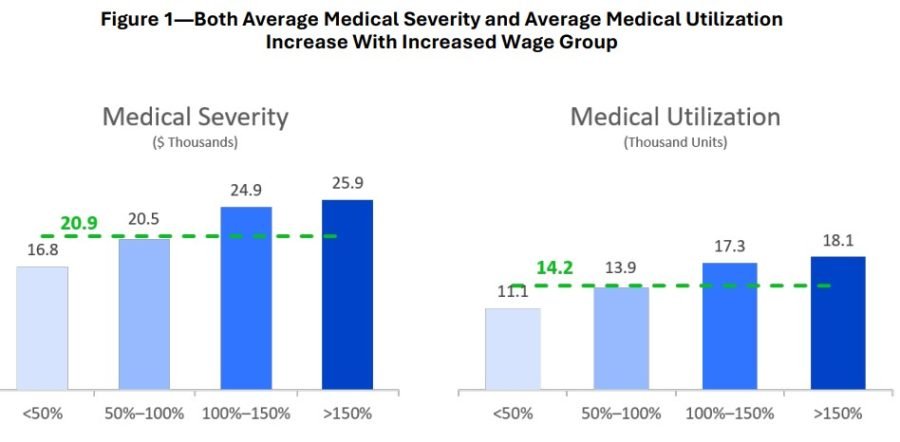
The study is based on a larger study that was presented at the NCCI 2026 AIS. Take 15 minutes out of your busy day and go over the info in the study. The graphs alone will be worth your time. I included one of the charts from the study at the end of this article.
From the study that covers many Workers Comp reserving insights – with my comments in < >’s
KEY FINDINGS Across 35 States
Medical utilization and medical severity increase as injured worker wages increase. The average medical
utilization for higher-wage workers making more than 150% of the state’s average weekly wage (SAWW) is about 1.6 times that of lower-wage workers making less than 50% of the SAWW. Similarly, a higher-wage worker’s medical severity is about 1.5 times that of a lower-wage worker.
The positive correlation observed in both medical utilization and medical severity indicates that the
differences are largely driven by the intensity of services and not prices.
The positive correlation between wages and medical utilization and medical severity persists across age
groups, industry groups, and jurisdictions. <great workers comp reserving insight>
Higher-wage workers are less likely than lower-wage workers to report less serious claims. As a result, they have a much lower share of less costly claims. They are about twice as likely to undergo major surgery as lower-wage workers, which puts upward pressure on medical costs for services such as professional, facility, prescription drugs, and medical equipment. <Risk Managers should look at this one closely.>